
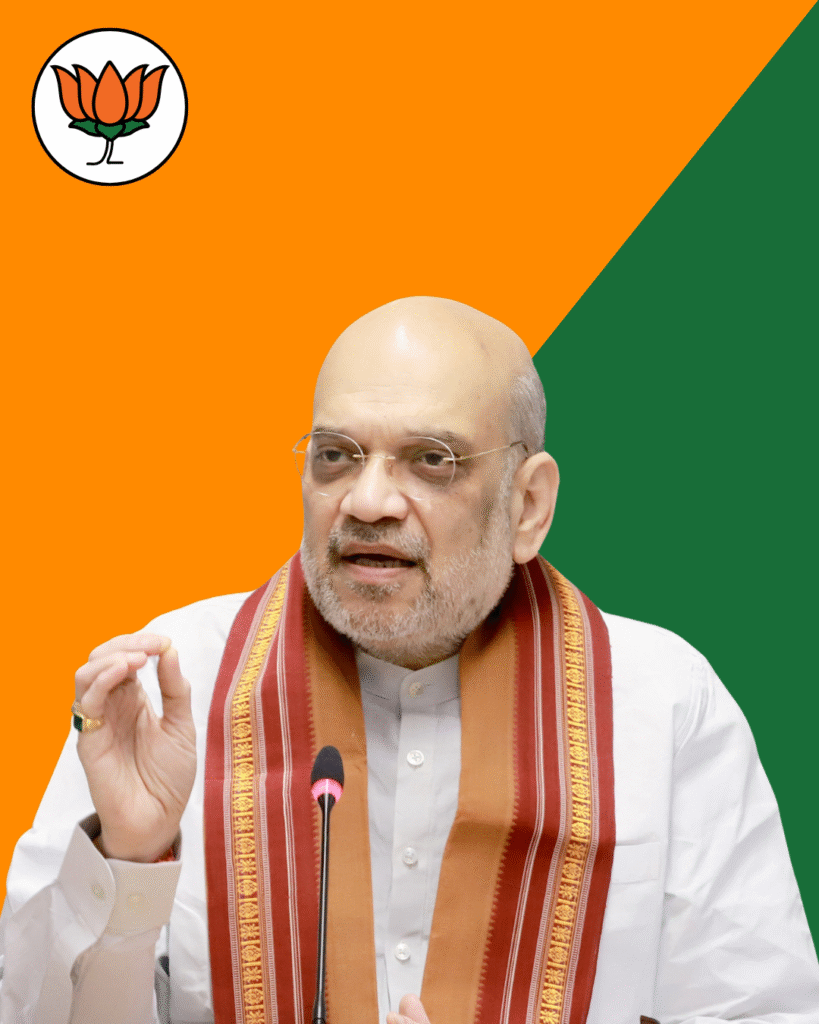
Amit Shah: The Strategic Brain Behind BJP's Rise
In the contemporary political landscape of India, Amit Shah stands out as one of the most influential and result-oriented leaders. Known for his sharp political mind, organizational discipline, and unmatched election strategy, Amit Shah has played a pivotal role in transforming the Bharatiya Janata Party (BJP) into the largest political force in India. As a close confidant of Prime Minister Narendra Modi, his contribution to both party-building and national governance continues to shape the future of Indian politics.
Early Political Journey: From RSS to BJP
Amit Shah’s political journey began in the early 1980s when he joined the Rashtriya Swayamsevak Sangh (RSS). His association with the BJP came naturally as the RSS is known for grooming ideological and disciplined cadres. This early training built the foundation for his strong organizational skills and deep understanding of grassroots politics.
His political career accelerated when he began working closely with Narendra Modi, who at the time was advancing through Gujarat’s political landscape. This partnership soon became one of the most influential alliances in modern Indian politics. Amit Shah gradually took on important responsibilities within the BJP’s Gujarat unit, earning recognition for his ability to mobilize teams, build networks, and analyze voter behavior with accuracy.
Rise in Gujarat Politics
A major turning point came when Narendra Modi became the Chief Minister of Gujarat in 2001. Amit Shah emerged as a key member of the Gujarat government, handling critical portfolios such as home, law, transport, and revenue. His strong administrative capabilities and connection with voters made him an indispensable part of the Modi-led government.
During this period, Shah demonstrated a unique ability to blend governance with political strategy. He built strong booth-level teams, strengthened BJP’s local units, and ensured that the party’s messaging reached even the smallest villages.
National Leadership: Expanding BJP Across India
After the BJP’s historic victory in the 2014 Lok Sabha elections, Amit Shah was appointed the National President of the BJP. Under his leadership, the party achieved dramatic expansion:
Winning major states like Uttar Pradesh, Haryana, Assam, Jharkhand, and Tripura.
Strengthening BJP’s presence in Eastern and Southern India, regions where the party previously had limited influence.
Creating the largest political party organization in the world with millions of active members.
Amit Shah brought a corporate-like professionalism to Indian political campaigns. He modernized election planning by introducing:
Booth-level micro-management
Data-driven voter analysis
Hyper-local campaign strategy
Digital outreach and targeted messaging
These methods reshaped how elections are contested in India and helped the BJP achieve unprecedented political dominance.
Election Strategy: The Modern-Day Chanakya
Often referred to as the “Chanakya of Indian Politics,” Amit Shah is known for his ability to craft winning strategies even in challenging environments. His handling of election campaigns focuses on:
Social engineering
Voter segmentation
Cadre mobilization
Real-time feedback system
Strong ground surveys
From the 2014 and 2019 Lok Sabha elections to multiple state elections, his strategies have consistently played a decisive role in BJP’s victories. His deep understanding of political psychology sets him apart from most contemporary leaders.
As Union Home Minister: Bold & Historic Decisions
In 2019, Amit Shah became the Union Minister of Home Affairs, one of the most powerful positions in the Indian government. His tenure has been marked by bold, transformative, and controversial decisions:
1. Revocation of Article 370
Ending the special status of Jammu & Kashmir, reorganizing it into Union Territories—considered one of the most significant decisions in India’s constitutional history.
2. Citizenship Amendment Act (CAA)
Providing citizenship to persecuted minorities from neighboring countries. Supporters view it as a humanitarian step; critics call it discriminatory.
3. NRC & Illegal Immigration
A tough stance on identifying illegal immigrants, especially in border states, in order to strengthen national security.
4. Focus on Internal Security
Enhancing anti-terror mechanisms, improving policing, and strengthening coordination between states and central agencies.
A Leader Loved & Criticized
Amit Shah remains a polarizing figure. Supporters admire him for his decisive leadership, political intelligence, and dedication to national interest. Critics argue that his strong positions reflect authoritarianism. Yet, irrespective of perceptions, his influence on India’s political, electoral, and governance system is undeniable.
He has redefined how elections are fought, how political organizations are built, and how national security policies are designed. Amit Shah’s journey—from an RSS volunteer to one of India’s most powerful leaders—continues to shape the nation’s future.